
A note before I start: AI is moving quickly, and this reflects my current point of view, shaped by what we’ve seen so far at DoorDash. I’ve seen meaningful productivity gains and teams answer questions they previously could not answer themselves. I’ve also seen incorrect analyses, weak assumptions, and false confidence. I expect this view to evolve as the technology, our capabilities, and our operating model evolve.
AI, Self-Service Analysis, and Accountability
AI is lowering the technical barriers to analytical work.
People who previously needed help writing a query, exploring a dataset, building a chart, or summarizing a result can increasingly do those things themselves.
That is a positive development.
More people can answer their own questions. Information becomes more accessible. Analytics teams can spend less time on mechanical requests.
But the fact that more people can perform analysis does not mean every analysis should be done by anyone with access to an AI tool.
Broader access creates two questions organizations need to answer:
Which analytical work should be distributed more broadly?
And:
Who owns the answer when that work is wrong?
Those questions are connected.
AI should broaden access to analysis. It should not eliminate standards, specialized expertise, or accountability.
Producing an answer is becoming easier
AI can increasingly generate queries, code, charts, summaries, hypotheses, first-pass analyses, and even recommendations.
That makes many parts of analytical production faster.
But as the cost of producing an initial answer falls, producing the answer itself becomes less of a differentiator.
The scarce parts of the work move elsewhere:
Choosing the right problem
Determining whether the data is appropriate
Checking definitions and assumptions
Distinguishing correlation from causation
Applying business and operational context
Understanding trade-offs
Making a recommendation
Knowing when there is enough evidence to act
Learning whether the decision worked
AI can help with all of these things.
What it cannot do is own the quality of the work or the consequences of the decision.
That makes human judgment and accountability more important, not less.
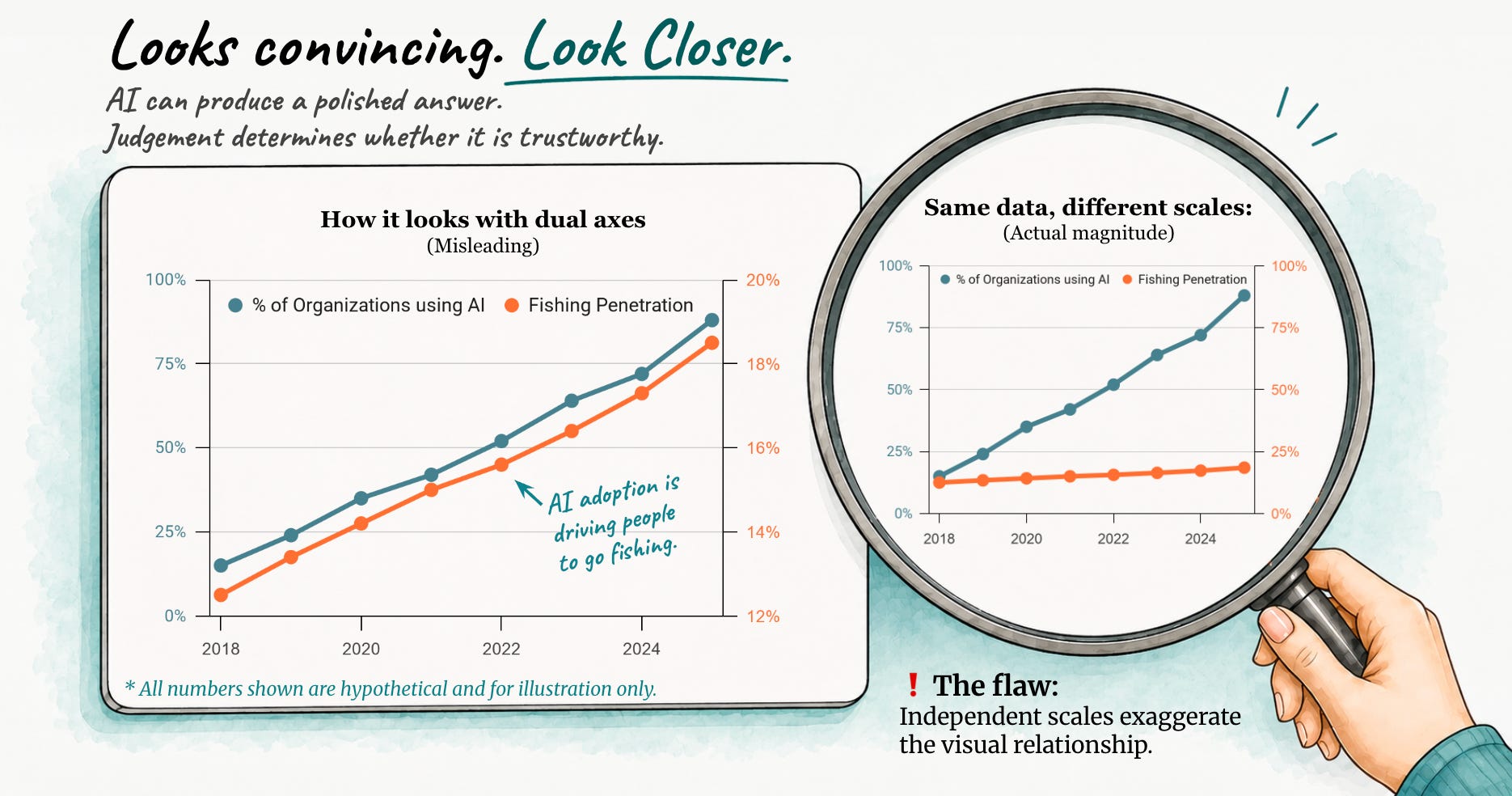
Match the rigor to the consequence of the decision
I do not think the goal should be to distribute all analytical work equally across the organization.
The goal should be to distribute the right work.
Some questions are relatively low risk.
Someone wants a directional read on a metric. A team wants to explore why something might be changing. The answer will inform a discussion but is unlikely to trigger an expensive or difficult-to-reverse action.
AI lets many more people answer those questions themselves.
That is exactly the type of work I want to see move away from a centralized Analytics team.
Other questions are different.
A pricing change that will affect millions of consumers. A major product launch. A large investment decision. A change to an important customer experience. A strategic decision with significant downstream consequences.
In those cases, getting the analysis wrong costs much more.
Even when AI makes the technical execution accessible, I still want people with deep analytical expertise involved in that work.
Technical execution is only one part of the skill.
Experienced analytical practitioners are more likely to recognize when the data is incomplete, when definitions are subtly wrong, when the methodology doesn’t support the conclusion, when an apparent relationship isn’t causal, or when business context changes the interpretation.
The routing principle I would use is simple:
The higher the consequence of the decision, the higher the bar for analytical expertise and rigor.
Before self-serving an analysis, ask:
What is the consequence if the answer is wrong?
How costly or difficult is the decision to reverse?
Does the work require specialized methodology or judgment to interpret correctly?
Low-risk, reversible, directional questions can increasingly be self-served.
High-risk, expensive, or strategically consequential decisions should involve people with the analytical expertise required to do the work responsibly.
In most organizations, much of that expertise will sit within Analytics.
This is not about protecting Analytics’ territory.
It is about putting expertise where the cost of being wrong is highest.
Accountability has to scale with access
Within an Analytics team, the chain of accountability is relatively clear.
The person doing the work is responsible for its quality. Their manager is responsible for maintaining the bar. Analytics leadership is ultimately accountable for the quality of work produced by the function.
We hire for the skills required to do this work well. We develop those skills over time. We use peer review and other quality checks where appropriate.
If an analysis is wrong because we used the wrong data, made a bad assumption, or applied an inappropriate methodology, we cannot blame the tool.
We own it.
As analytical capability spreads beyond Analytics, that accountability has to spread with it.
I cannot be accountable for every AI-generated analysis produced across an organization simply because it involves data.
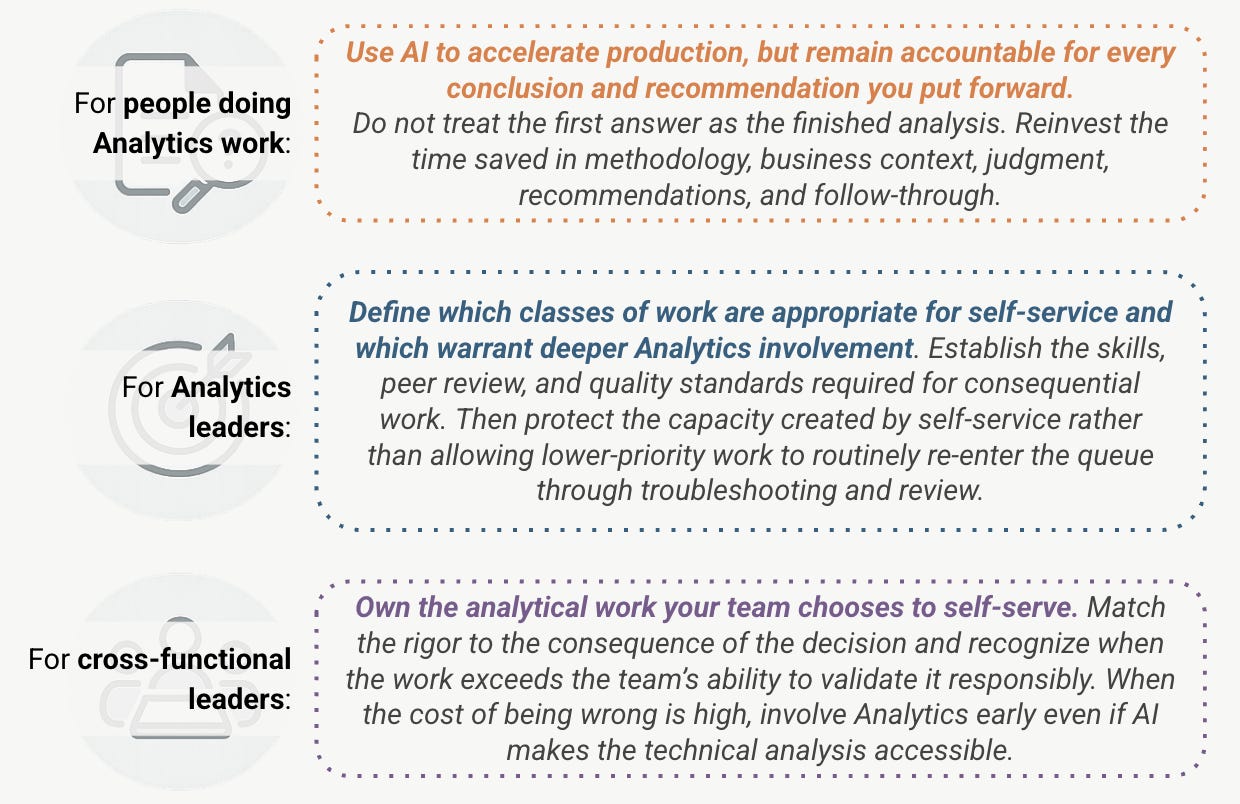
If a Product, Operations, Marketing, Finance, or other team chooses to self-serve an analysis, the people producing that work and the leaders managing them need to own its quality in the same way I own the quality of work produced by Analytics.
AI makes that especially important because it can make weak analysis look polished and authoritative.
A query can run and still answer the wrong question.
A chart can look convincing and still use the wrong denominator.
A recommendation can sound coherent and still rest on weak evidence.
AI can produce. Teams must own. Leaders must decide.
The team producing the work is accountable for ensuring it is reliable enough for its intended use.
The leader acting on it is accountable for deciding whether the evidence is sufficient for the consequence of the decision.
And if a team cannot responsibly determine whether its own analysis is reliable, that signals the work may not be appropriate for self-service in the first place.
Self-service analysis must distribute capability and accountability together. “AI got it wrong” cannot become a substitute for human ownership.
Analytics should not become the homework grader
There is an obvious but wrong response to these risks: require Analytics to review or troubleshoot everything produced elsewhere.
That would recreate the exact bottleneck self-service is supposed to remove.
It would also put accountability in the wrong place.
Imagine the Analytics team has ten priorities and has deliberately chosen to focus this sprint on the top three.
A Product Manager decides to independently tackle priority nine using AI: an exploratory question about a recent conversion decline in one market.
That can be a great outcome.
If the PM can answer the question independently, work that otherwise would have waited gets done without consuming Analytics capacity.
But suppose the PM gets stuck, cannot explain why the result looks wrong, and ultimately needs a data scientist to spend their whole day debugging the analysis.
We have now effectively moved scarce Analytics capacity away from priorities one through three and redirected it to priority nine.
The operating model has broken down.
A healthy self-service model still needs an escape hatch. Occasionally, someone will uncover a real data-quality issue, ambiguous definition, or unexpected result that warrants Analytics involvement.
The failure mode is not escalation itself.
It is when escalation becomes the normal path for completing self-service work.
Self-service creates leverage when teams can complete lower-risk work with limited Analytics involvement. That requires trusted data, clear metric definitions, reusable capabilities, and accountability for the work they choose to self-serve. One of Analytics’ highest-leverage roles is to build those foundations, so other teams can answer more questions safely without requiring ongoing Analytics support.
The capacity created should then move Analytics closer to the higher-risk, higher-value decisions where specialized judgment matters most.
Self-service should remove lower-priority work from the Analytics queue, not quietly put it back through a different door.
Every tool raises the bar
I have seen versions of this transition before.
When I joined DoorDash, every new cut of data required help from an engineer, so I learned SQL.
Later, I learned enough Python to work around the limitations of our existing tools.
Neither technology made Analytics less valuable.
Each lowered execution costs and raised the bar for what Analytics could contribute.
AI will do the same, but on a much larger scale because it distributes analytical capability across the organization.
That should free Analytics to spend more time on the work where judgment matters most: framing important problems, designing stronger tests, working through causal questions, developing clearer recommendations, and helping leaders navigate difficult trade-offs.
If AI lets an Analytics team produce twice as many analyses but doesn’t improve the quality of important decisions, the team hasn’t become twice as valuable.
The opportunity is to turn speed into greater impact.
Putting this into practice
The bar
AI will make analysis more abundant.
That is not the same as making good judgment abundant.
The organizations that benefit most will not simply distribute analytical capability as broadly as possible.
They will know which questions can safely be decentralized and which decisions deserve specialized expertise.
They will distribute accountability alongside capability.
AI changes who can produce analysis. It does not change the fact that someone needs to own the answer.
Acknowledgements: The ideas and writing are mine, but they’ve been shaped by current and former teammates who challenged my thinking and helped evolve how we built and ran the Analytics team. Special thanks to my Chief of Staff, Anita Chan, for brainstorming, editing, and AI wizardry on the images, and to ChatGPT and Claude for serving as editorial critics.
Another awesome one! thank you!
Amazing article! How does one bridge the gap between someone who now uses AI for the hard part of technical work (writing scripts, running a correlation analysis) learn or read about to raise their bar to be a better analyst as well