Building a World-Class Analytics Team (Part 1) - From Outputs to Outcomes
Redefining the Role of Analytics.
The question that started a career.
The original spark for Analytics at DoorDash came from a simple question: “How do we know if a market launch is going well?”
At first, I thought this was a measurement problem.
We needed better metrics, better dashboards, and a consistent way to compare performance across markets.
Those things mattered. But they weren’t the hardest part.
The real challenge wasn’t measurement. It was decision-making.
We needed a shared definition of good performance. We needed to understand which outcomes mattered, which inputs teams could control, but most importantly, we needed to identify what leaders should do when performance moved off plan.
The question wasn’t simply “What should we measure?”
It became: “What decision are we trying to make, and how can data help us make it better?”
That question eventually became BizOps. Later, it evolved into Analytics.
What is Analytics?
People often ask me what an Analytics team does. My answer has stayed remarkably consistent: Analytics exists to help the business make better decisions and improve measurable outcomes.
Most Analytics leaders would probably agree with that statement. The challenge isn’t defining the purpose of Analytics. It’s building a team—and an organization—that consistently operates that way.
A useful Analytics team answers questions, builds dashboards, analyzes experiments, and makes information easier to access.
A great Analytics team goes further. They help define the problem, bring a point of view on the decision, and stay involved long enough to learn whether the decision worked.
That’s what I mean by owning the outcome.
It doesn’t mean Analytics owns the business result on their own. It means Analytics shares responsibility for the quality of the decision by ensuring the team:
Asked the right question.
Used the right evidence.
Understood the relevant trade-offs.
Made a clear decision.
Learned from what happened next.
Four questions behind every Analytics request
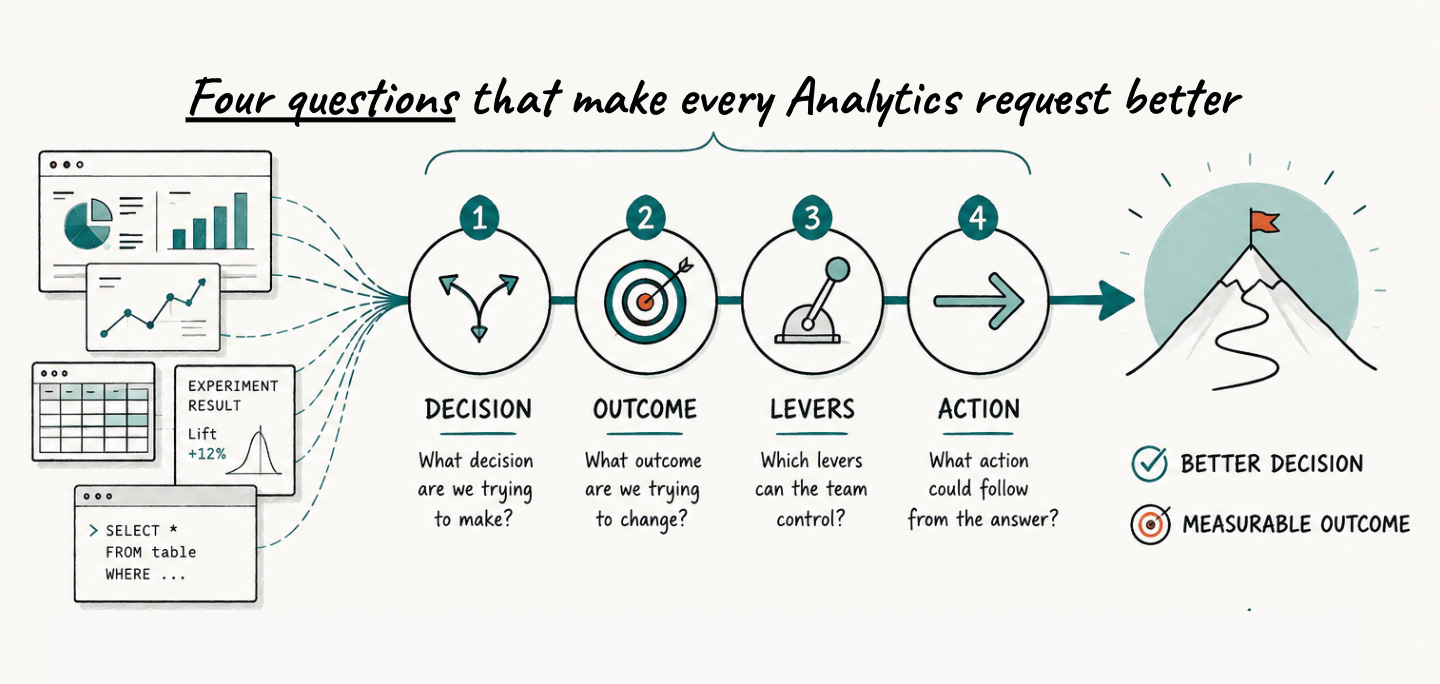
I've found that nearly every Analytics request becomes better after answering four questions.
1. What decision are we trying to make?
Dashboards, analyses, and forecasts aren’t decisions. They’re inputs into one.
Before starting the work, identify what someone will do differently as a result of the answer.
2. What outcome are we trying to change?
What does success look like for the business or the customer?
This prevents teams from optimizing a convenient metric without understanding whether it drives the result that actually matters.
3. Which levers can the team control?
Teams cannot directly control every outcome.
They can usually control inputs such as pricing, targeting, product experience, selection, incentives, staffing, execution quality, or the pace of investment.
Good Analytics connects those controllable inputs to the outcomes the business cares about.
4. What action could follow from the answer?
What would we do if the metric is above a certain threshold? Below? Inconclusive?
If every answer results in the same action, the analysis may not be necessary.
These four questions may sound basic. But answering them changes the nature of the work.
From the requested output to the desired outcome
Imagine a GM asks for a market-launch dashboard.
A request-driven approach starts by asking, “Which metrics should go on the dashboard?“
An outcome-driven approach starts somewhere else: “What decision does the GM need to make?”
Perhaps the real decision is whether to expand the launch, change the launch strategy, or pull back the current investment.
That leads to a different set of questions:
What outcomes define a healthy launch?
What early indicators predict those outcomes?
Which inputs can the local team influence?
What would cause us to expand, intervene, or stop?
How quickly should we expect each indicator to move?
Who owns the next action?
The team may still build a dashboard. But the dashboard is now part of a decision system, not the final product.
Most Analytics requests hide a more important decision.
The most valuable work often begins when someone is willing to go one step beyond the original ask.
Earning the seat at the table
Analytics earns its seat one better decision at a time.
The goal isn't to be invited to every meeting or copied on every planning document.
The goal is to become so valuable that teams don't want to make important decisions without you.
You bring facts.
You bring business context.
You identify risks and tradeoffs.
You challenge assumptions.
You recommend a path forward.
Over time, consistently improving decision quality earns Analytics a place in the conversations that matter most.
It's difficult for Analytics to have the greatest impact when they’re engaged too late in the decision-making process. Common patterns include:
Sizing an opportunity only after it has already been prioritized.
Validating a plan once the strategy is largely set.
Reporting on performance after the most important decisions have already been made.
This usually isn't the result of anyone intentionally excluding Analytics. Rather, it is the byproduct of the way many organizations work.
A request comes in. Analytics responds. The immediate problem gets solved.
Over time, Analytics becomes highly effective at supporting decisions, but has fewer opportunities to influence them.
Changing that operating model doesn’t happen by declaring that Analytics works differently.
It changes by repeatedly demonstrating that involving Analytics earlier leads to better plans, clearer decisions, and stronger outcomes.
Putting this into practice
Before discussing hiring, organizational structure, culture, measurement, or AI, you first need to agree on the role Analytics is expected to play.
This is the first principle: Analytics exists to help the business make better decisions and improve measurable outcomes.
And it changes everything: how you hire, how you organize and develop the team, how you measure success, and how you use AI.
That is what this series explores: what world-class Analytics looks like, how to build it, and how the function needs to evolve.


This is really awesome. Simple and clear but extremely impactful
Looking forward to reading the rest of the parts!