
Few decisions shape what a team becomes more than who you hire.
After more than a decade of hiring for Analytics at DoorDash, there are a few things I won’t compromise on. Some I’ve held from the start; others I learned from mistakes. I’ll break it down into four questions: what actually matters, how I test for it, how I make the call, and what I owe the people I’m hiring.
What actually matters
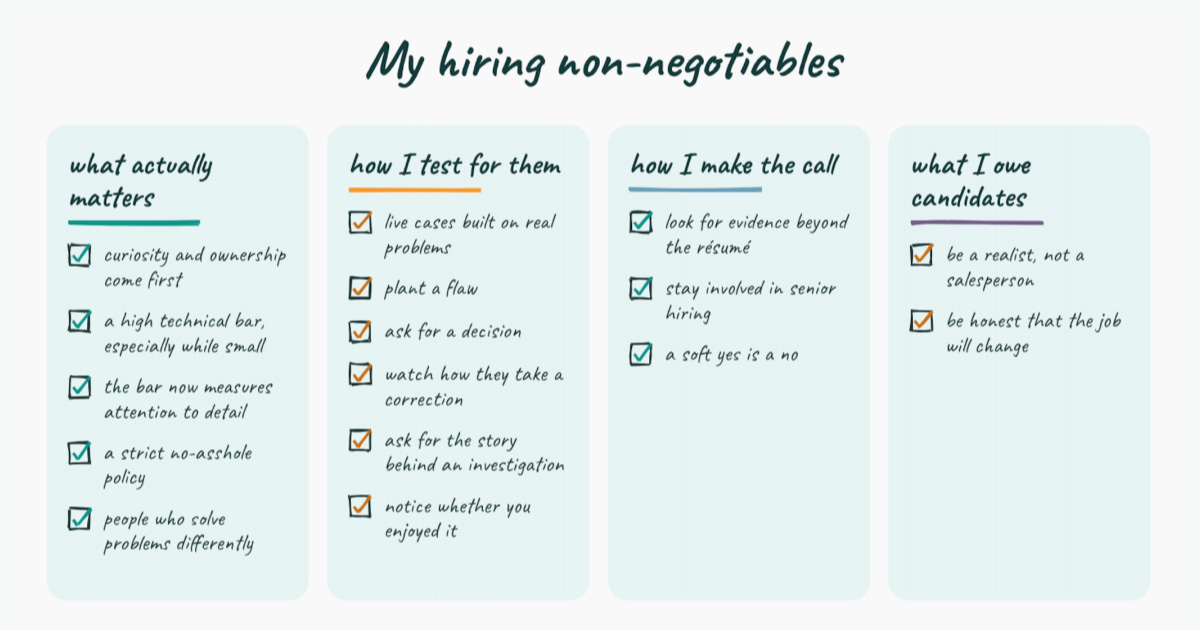
Curiosity and ownership come first. These are the traits I’ve seen most consistently in the strongest people on my team, and curiosity in particular is one I haven’t found a way to teach. It shows up in the person who notices that something seems off and goes to find out why, without being asked. Ownership is what happens next: they take responsibility for getting to an answer, work with others to get there, and don’t stop when the next step falls outside a narrow definition of their role.
Hold a high technical bar, especially while the team is small. When the team was small, I hired someone who didn’t quite meet our technical bar because I thought we could coach them into it. It didn’t work. We didn’t have the time to invest in them the way they needed, and they were slower to pick up the skill than we’d expected. The combination made it a poor fit, and they eventually moved to a different team. A skill being teachable doesn’t mean your team has the capacity to teach it on the timeline the role requires. A high technical bar is right at any stage, but on a small team everyone needs to carry their own weight and operate independently.
The bar is still high, but what it measures has changed. Remembering every piece of SQL syntax without a reference was already less important to me than being able to look at a query and tell whether it’s right. AI makes that shift much bigger. Raw technical skill matters less when an agent can do much of the execution, as long as you understand enough to direct it toward the right outcome. What matters more is attention to detail: spotting errors in logic, in code, and in approach, and recognizing when something looks good but isn’t. I also look for people who want to use AI to build tools and processes, not only to speed up an analysis. We didn’t use to treat building as a distinct skill. I do now, and one of my favorite questions is what a candidate has built for themselves, whether in their current role or in their personal life.
I have a strict no-asshole policy. I want to like the people I work with, and I have no time for people who play politics or aren’t team players, no matter how talented they are. At DoorDash, the company comes first, then the team, then the individual. I look for people who are aligned with that and who want to be part of a team. Likeability matters beyond the team, too. DoorDash is highly cross-functional, and being able to get along with technical and non-technical partners across Marketing, Sales, Product, Engineering, and Operations is a big part of doing the job well.
I look for people who solve problems differently than I do. Early on, we hired David, and we rarely broke a problem down the same way. I tended to start from the business logic. David broke everything into its underlying formula and treated it like a math equation. When we reached the same answer through different approaches, we felt much more confident. Some problems were easier to solve his way, and some were easier to solve mine, and we benefited from both. I look for that across the team now: people with different backgrounds and strengths, who are strong where others are weaker. The team ends up stronger than any individual.
How I test for them
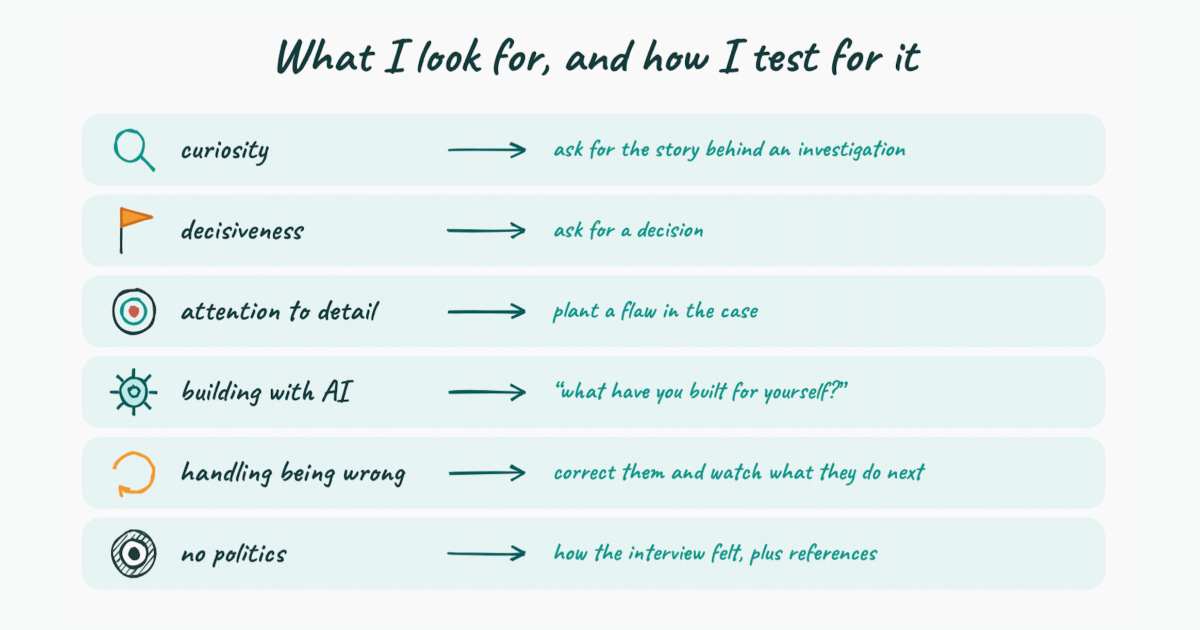
Use live cases built on real problems. We replaced our take-home with a live coding exercise and a live case study. Our cases are real problems DoorDash has faced, such as a consumer app redesign, Dasher supply, or an underperforming city. The job requires absorbing new information in real time and problem-solving on the fly, and a live case is the closest I can get to watching someone do that. A take-home also hides how long the work took: two candidates can submit identical analyses after one hour or after eight, and time-boxing a take-home fairly is harder than it sounds.
Plant a flaw and see who catches it. In our early take-home, before we moved to live cases, every timestamp in the data was in UTC instead of local time. It wasn’t intentional; that was how the data was stored. But we were based in San Francisco and only interviewing in the Bay Area, so the data looked absurd: lunch looked like dinner, and our real dinner peak showed up as a spike at 2 a.m. I kept it in because it turned out to be a great screen for attention to detail. Some candidates never noticed the strange distribution. Some noticed it and assumed it was a data mistake. And some recognized that the timestamps were in UTC, converted them, and kept going. That third group is who I want to hire.
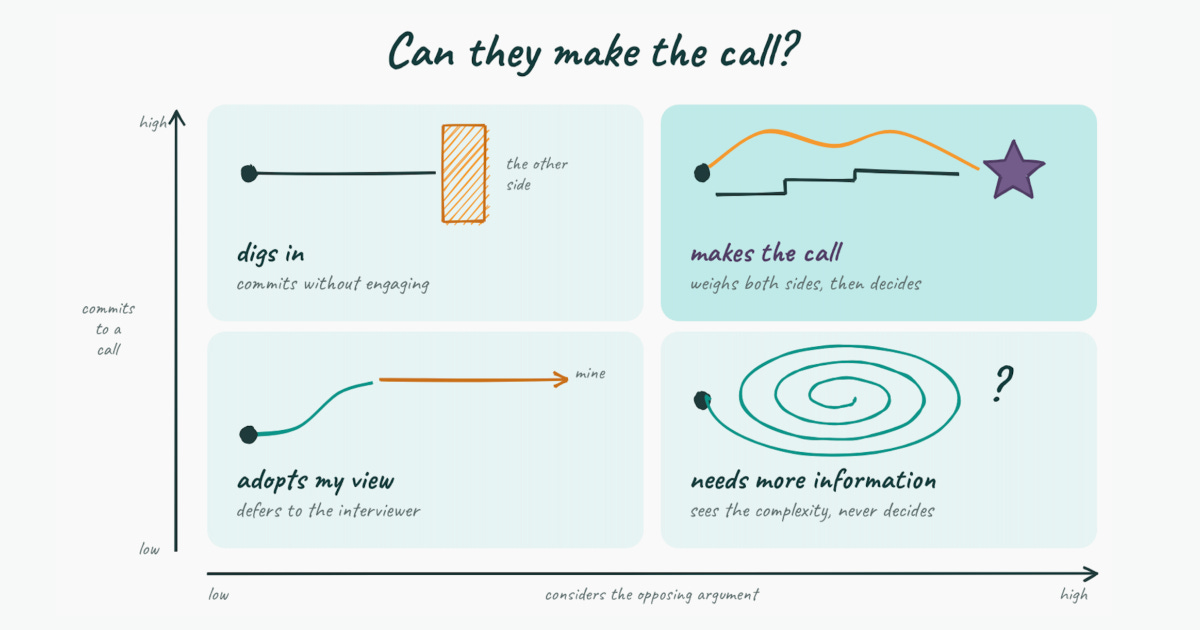
Ask for a decision. A candidate may lay out the case for two or three approaches, and I want them to see that complexity. But I still need to know which one they would choose and why. We rarely have full information, and the work has to keep moving, so I need people who can put a stake in the ground even with limited data. One way I test this is by raising information that supports the opposing argument, something important the candidate hadn’t considered. Once we’ve discussed it, I ask whether, knowing what they know now, they would change their mind. The ones I want weigh both arguments and make a call, whether that means changing their answer or defending it, and can explain why.
Watch how someone takes a correction. Most candidates get something wrong in a case, because I know the business better than they do. When that happens, I point it out. Do they get defensive, or do they use the feedback to ask questions and understand what they missed? I want people who find that energizing, or at least aren’t thrown by it. A little self-frustration is a good sign. It shows they care and hold themselves to a high bar.
Ask for the story behind an investigation. Curiosity is hard to see in a case, so I also ask candidates for examples from their own work. The strongest answers follow a pattern: they noticed something odd, went looking for why, and each finding led to the next question until they had something the business could act on. You can hear it in how they tell the story. They’re as excited about the investigation as the answer.
Notice whether you enjoyed the interview. Whether someone plays politics or puts themselves ahead of the team is the hardest thing to test for. One signal I pay attention to is how the interview felt. Did I have fun problem-solving with this person? Did they bring positive energy? An interview is a conversation much like the ones you’ll have on the job, and I want those to be enjoyable. It’s an imperfect signal, since someone can be pleasant in an interview and still play politics on the job, so we also use reference checks as another source of information.
How I make the call
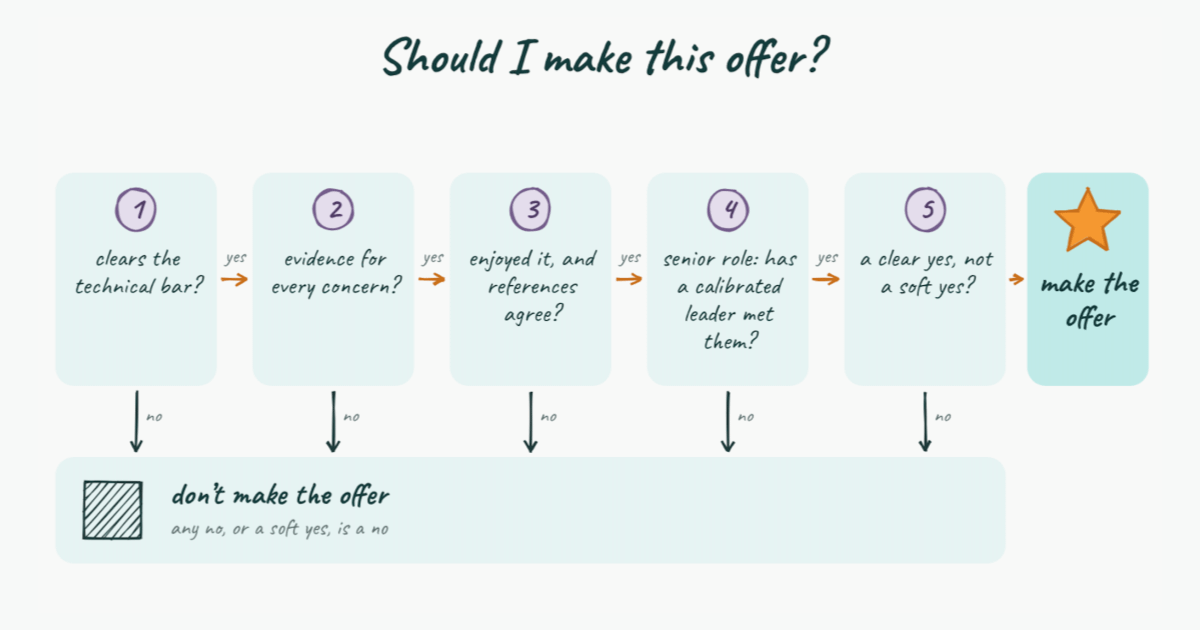
Look for evidence beyond the résumé. The size of the organization someone managed, the scope of their title, or whether they managed managers is context, not evidence. I care much more about what they actually did: what they shipped, which decisions they made, which conflicts they worked through, and what changed because they were involved. We hired Triston from an insurance company, not the first background most people picture when hiring for a consumer tech company. He came from a more mature analytics organization and had a strong perspective on how our team needed to develop to supercharge our impact and scale better across the organization. For example, he helped me put together our first leveling guide to outline roles and expectations on the team, drawing on what had and hadn’t worked at his previous companies.
Internal candidates can offer the best evidence, because you can watch them do parts of the job first. With an over-extended Analytics team, I asked James to take on DoorDash Drive’s data, metrics, and analysis while he was still working on the Operations team, so by the time he formally joined my team, I’d already seen how he worked. Coming from Operations, he also knew what it’s like to be an operator, which made his analytical judgment more useful.
Stay involved in senior hiring longer than feels necessary. Leadership hires shape who else joins the team. Someone who doesn’t meet the bar shouldn’t set it: weak leaders are much more likely to hire weak individual contributors, and that’s how you end up with an entire weak team. For many years, I interviewed and hired everyone at director level (L8) and above. A few years ago, I raised that to senior director (L9) and above, and I still occasionally interview at the director level.
If it’s a soft yes, it’s a no. When I’ve looked back at the interview scorecards for the strongest people I hired, they were almost all clear yeses. That pattern has made me more careful about any decision that depends on explaining away a concern rather than having convincing evidence that someone can do the job.
What I owe the people I’m hiring
Be a realist, not a salesperson. Hiring is also an assessment the candidate is making about us. Some people will oversell a role and “sell the dream,” and the new hire discovers the gap after they’ve joined. I want to be clear about the upside, the opportunity, and the vision for the company and the team, but I’m an extreme realist about both the good things and the challenges.
In DoorDash’s early days, we couldn’t match the salaries at the largest technology companies. What we could offer was direct business impact: find an insight, make a recommendation, and see it implemented quickly. That was not the right trade for everyone, and I’d rather a candidate understand the job and decide against it than join a version of it that doesn’t exist. I think that honesty is part of why people have stayed on the team for a long time.
Be honest that the job will change. In a fast-growing company, the role you’re hired for may not be the role you end up doing, sometimes before you even start. Lokesh joined Analytics as a senior manager, hired for one team. Between when we hired him and his start date, our priorities shifted, and we needed a strong lead in a different area, so on his first day we asked whether he’d be open to a completely different role. He said yes, led that team for a few years, and later moved to lead another domain within Analytics. I tell candidates up front that this can happen. What I want in return is an informed decision: people who join because that kind of change excites them, not people hoping the job stays exactly as described.
Who you hire shapes what your team becomes. These are the places I don’t compromise.
Acknowledgments: The ideas and writing are mine, but current and former teammates shaped my hiring philosophy by challenging my thinking and helping refine how we hire. Special thanks to the great people I’ve hired who raised the bar, and to my less-than-stellar hiring decisions, which taught me equally valuable lessons. As always, thanks to my Chief of Staff for brainstorming and editing, and to Claude and ChatGPT for editorial feedback and AI-powered image creation.
🙌🏻🙌🏻🙌🏻🙌🏻
Jess, thanks for sharing the framework! It’s really refreshing to see how leadership evaluates candidates from the other side of the table. The one part that felt a bit discouraging was, "I thought we could coach them into it." With AI and data systems evolving so rapidly, even the most technically savvy engineers won't know every tool out of the gate and will constantly need to learn on the job. If the judgment trait also factored in a candidate's adaptability and ability to ramp up quickly, I think it would identify even stronger long-term team members