
After the emotional ups and downs of starting (and ultimately shuttering) GiftSimple, I found myself at a crossroads. I took stock of my experience—a failed bank and a failed startup—and wondered what I could do with that mix.
I considered going back to finance. By then, the markets had recovered, and it seemed like a logical option. But deep down, I knew it still wasn’t the right long-term fit for me, and it felt like moving backward rather than building on everything I had just learned.
Around that time, a classmate of mine became a General Manager (GM) at Uber and described the role as a “CEO of your city.” It sounded like a great opportunity to combine the entrepreneurial spirit I loved with the support of a larger team. I was intrigued and wondered what other roles like this might exist.
Finding DoorDash was a little accidental.
Although I never raised any venture capital for GiftSimple, I had met a few folks at various VC firms. Jamie Bott, who was a talent partner at Sequoia Capital, first introduced me to Tony Xu. It was April of 2014, and Alfred Lin had signed a term sheet to lead DoorDash’s $17.3 million Series A funding round. DoorDash was looking to expand beyond Silicon Valley and needed its first General Manager to launch new markets.
At the time, almost no one knew what DoorDash was. I lost count of how often people thought I said I worked for “Jordache,” the 90s denim brand.
The interview process was informal. My first call with Tony took place while he was walking the streets in LA, visiting merchants ahead of the planned summer launch. I completed a take-home exercise analyzing some market data in Excel and had a video interview with co-founders Stanley and Andy, where we talked basketball and compared DoorDash’s assignment algorithm to a zone defense! In those days, Tony personally interviewed and reference-checked every hire. I received an offer pretty quickly after that—you don’t need many interview rounds when the final decision-makers are already involved. The process is much more structured now, but at the time, it reflected the company’s stage: small, fast, and founder-led.
Ultimately, I decided to join for two reasons:
First, I was impressed with Tony. He had a long-term vision for what he wanted to build—a local commerce platform—but was able to get down to the lowest level of detail about what needed to be done today, tomorrow, and next month. He had the unique ability to zoom in and out as needed, and he was incredibly smart yet humble. I met many founders at Wharton and while working on GiftSimple. It was rare to find someone who could operate at both levels so naturally.
Second, the opportunity sounded exciting. I would join as the first GM, head straight to Los Angeles to help launch the market, and then continue launching cities until I found one I wanted to run longer term.
Launching a market meant doing everything.
The job was all about hustle and rapid execution in those early days. There wasn’t much data to analyze, even if we’d had the time to try. Instead, it was a lot of trial and error—throwing ideas at the wall to see what worked.
Going door-to-door signing up merchants? Check.
Running twice-daily Dasher orientations? Check.
Writing handwritten thank-you notes to consumers to slip into delivery bags? Check.
Interviewing candidates for the open roles on the local team? Check.
Breaking down boxes and taking out the trash? Check.
Learning how to optimize Google Ad campaigns? Handing out promo codes at Santa Monica Pier movie nights? Unpacking boxes of doorhangers we’d hang in neighborhoods while doing deliveries? All done.
It was relentless, gritty, and wildly energizing.
We worked seven days a week, often crashing on air mattresses in the office or inexpensive Airbnbs. My first night in LA was spent in a tiny Venice apartment overrun by two cats and an unbearable stench. It was so bad that one teammate opted to sleep in the office on cardboard boxes instead. After pleading with Airbnb, we got a new place—only to discover it was crawling with ants. A quick trip to Ralph’s grocery store on Lincoln Ave for cans of Raid solved that problem, and we got back to work.
After launching LA and leaving the market in the hands of the permanent local team—shout out to Casey North—I moved on to Boston.
Boston would introduce three new challenges for us: the Eastern time zone (our team had only operated on Pacific time), cold weather (it was the fall of 2014), and bicycles (until this point, DoorDash was 100% car delivery). Boston was different.
I spent seven months in Boston, including the snowiest month on record in February 2015.
Back then, we were only open for lunch and dinner. We closed from 2 to 5 p.m., and ran Dasher orientations in our office. During dinner, from 5 to 10 p.m., we rotated manning our dispatching tool. We manually assigned Dashers to orders while our engineering team worked to build vehicle type into the assignment algorithm.
We had competitions over who could get to 0% lateness. I took this seriously and often won, which I’m sure will surprise no one who has worked with me. But the part I found most interesting was understanding why an assignment was good or bad in the first place.
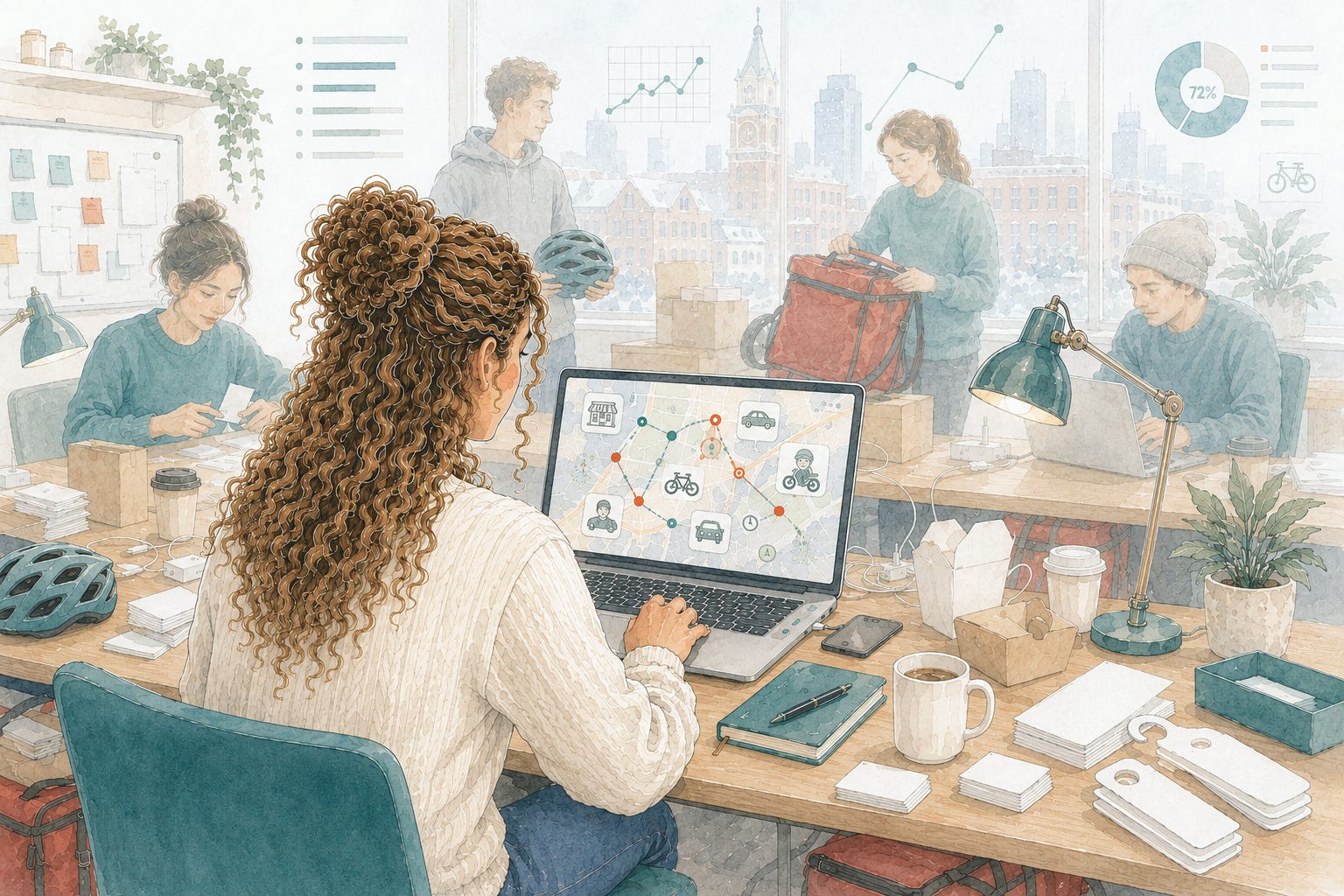
I wanted to understand why.
We started manually scoring assignment quality and sending feedback to Rohan and the engineering team: where the algorithm was working, where it was struggling with bikes, and what seemed to be driving lateness. That tight loop between what was happening on the ground and what we could measure was my first glimpse of how I would think about analytics for the next decade.
I loved that part. In hindsight, that probably should have been a clue. I was most energized when there was a system to understand, a metric to improve, and a clear connection between the work and the outcome.
What caused lateness? What was in our control? Which actions actually moved the metric? Where was the bottleneck? How could we make the process better the next day?
The rest of the job was much less analytical and much more hustle. We woke up at 5 a.m. to stand outside various Boston T stations in the middle of winter, handing out KIND bars with promo codes to morning commuters. We took out the garbage to the dumpsters on Saturday nights and celebrated by playing dice games and eating ice cream in the office. In the evenings, we would send apology emails to everyone who had a late order. Every day was an opportunity to grow the business: sign new merchants, onboard new Dashers, acquire new consumers, fix whatever broke, and then do it all again the next day.
I was an average GM, but it wasn’t my superpower.
I worked hard, got the job done, and was willing to do whatever needed to be done. But the role—especially in those early days—did not play to my strengths.
The best early GMs were energized by the constant hustle: putting out fires, rallying teams, and making dozens of judgment calls with imperfect information. It was gritty, fast-moving work, and I had a lot of respect for the people who were great at it.
But what I gravitated toward was different.
I was more interested in zooming in. I wanted to understand the mechanics underneath the outcomes. Why was one assignment late and another on time? Which factors actually mattered, and which were just noise? What made one launch more successful than another? How could we compare Boston to LA or Chicago in a way that was fair and useful?
One of DoorDash’s operating instincts is to look beyond the averages and understand the outliers. That’s where I was naturally drawn. The exceptions were often where the best lessons were hiding.
I believe you can do almost any role reasonably well for a period of time, even if it is not the perfect fit. But eventually, you should seek out work that plays to your strengths. For me, that meant moving closer to the questions behind the work: what matters, how we measure it, and what “good” actually looks like.
The question that changed my career.
Around this time, Tony was managing several GMs and wrestling with a similar question: How do you hold GMs accountable when the markets they run are so different?
What does a “good” launch look like? Measuring GMs on raw activity was not enough. Signing restaurants mattered, but not all restaurants were equally valuable. Onboarding Dashers mattered, but only if we had the right supply at the right times and in the right places. Handing out promo codes mattered, but only if those customers actually ordered, retained, and helped build a healthy market.
At one point, Tony said something along the lines of, “I don’t know how to goal my GMs. Could you figure that out?”
That conversation changed my career. Instead of moving on to the next market launch, I moved into something much less defined: figuring out how to set the right goals, measure launch success, understand unit economics, think about Dasher supply, and identify the inputs that actually made the DoorDash flywheel work.
The role did not have a name at first. Around that time, I had read a piece by Dan Yoo about BizOps teams at Yahoo and LinkedIn—groups of generalists who acted like Swiss army knives, dropping into ambiguous business problems, figuring out what was going on, solving what they could, and then handing things off once the work became more repeatable.
That sounded a lot like what DoorDash needed. So I called my role BizOps.
The right move does not always look like a step up.
People often think about careers as a linear path: the next role, the bigger role, the one that looks more impressive on paper. This was not a promotion. I had expected to keep launching markets until I picked one to run permanently, but instead, I was joining Finance in a new role with no established team, no clear playbook, and no guarantee it would become anything meaningful. You could argue it was a step sideways. Maybe even a step down?
But it was the right move because it was the right fit. It was work I was excited about, work where I thought I could add real value to the business, and work that pulled me closer to the questions I could not stop thinking about.
Looking back, it is easy to make the story sound intentional and strategic. It was not. Living it felt much more like a squiggly line: a failed bank, a failed startup, a GM role that was not quite the right fit, and then an undefined problem that eventually became a function.
That was the turning point.
I had joined DoorDash to be a GM. I stayed because I found the work that actually fit me—and because I got to keep working alongside some of the best operators I had ever met.
Coming up in Part 5: how that undefined problem became the beginning of DoorDash’s Analytics function.
Look beyond the averages and understand the outliers; the exceptions are often, where the best lessons were hiding..🙏