Building a World-Class Analytics Team (Part 2) - From Reporting to Recommendation
The “So What?” Habit.
The step that is easy to skip.
Part 1 started with a simple principle: Analytics exists to help the business make better decisions and improve measurable outcomes.
Most Analytics teams already know this.
Yet many analyses still stop one step too early.
They explain what happened.
Sometimes they explain why.
Then they stop.
The most valuable question comes next: “What should we do?”
That’s the “so what?” and the difference between reporting and recommendation.
A good analysis helps people understand the business. A great analysis helps them decide what to do next.
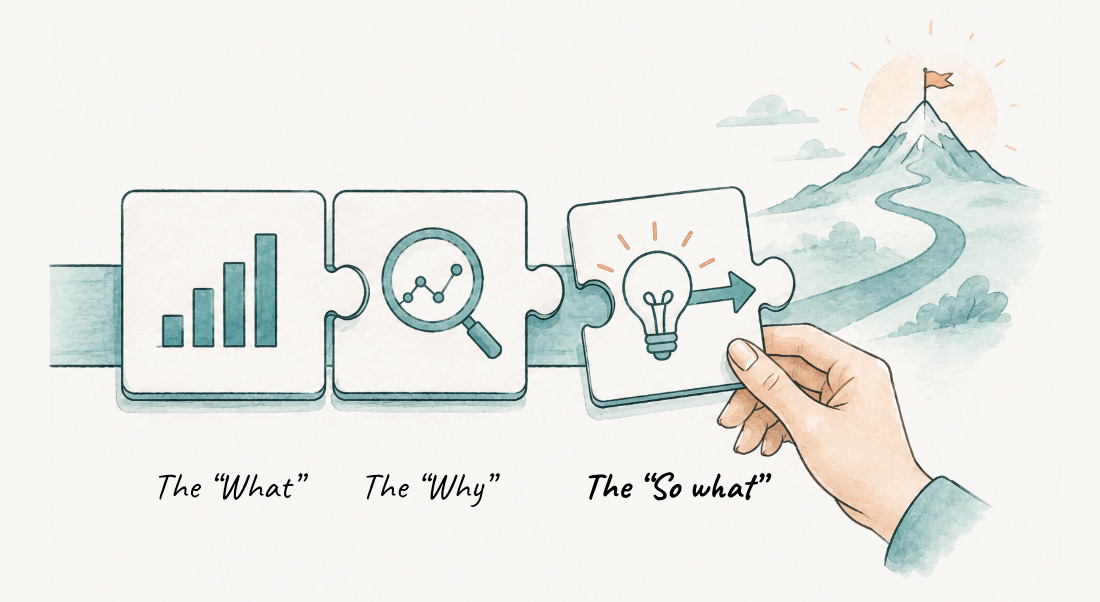
What decision-ready analysis looks like
Every important analysis should answer five questions before it leaves your desk.
1. What happened?
State the facts clearly.
What changed? By how much? For whom? Relative to what baseline?
The audience shouldn’t need to interpret ten charts to understand the headline.
2. What does it mean?
Interpret the evidence.
Separate what the data shows from what you believe is the most likely explanation. Be explicit about whether you’re identifying a causal relationship, a likely driver, or simply a correlation.
3. What should we do?
Make a recommendation.
Don’t force the audience to infer your point of view.
If the right answer is to gather more evidence, explain exactly what evidence is missing, how you’ll get it, and how it could change the decision.
4. What are the tradeoffs?
Every recommendation has costs, risks, assumptions, and uncertainty.
Explain them.
Uncertainty shouldn’t weaken a recommendation. It should make it more credible.
5. What happens next?
Define the action, owner, timing, and success criteria.
If nobody knows what happens after reading the analysis, the analysis isn’t finished.
If every important analysis in your organization followed this structure, decision quality would improve dramatically.
Judgment is not the opposite of rigor
Businesses rarely have perfect information.
There is almost always another analysis that could be run, another experiment that could be designed, or more data that could be collected.
If you wait for certainty, you will almost never make a recommendation.
That discomfort is real.
People doing Analytics work are trained to distinguish evidence from inference, surface limitations, and avoid overstating what the data can prove. Those instincts are essential.
But rigor should not become an excuse to avoid judgment.
Analytics is not the police. The role is not to assign blame or declare that a decision succeeded or failed. It is to partner with the business to understand what happened, identify which assumptions proved right or wrong, and improve the next decision.
The best Analytics teams are in the problem with their cross-functional partners, not standing on the sidelines evaluating them. That mindset creates collaboration instead of defensiveness, and learning instead of blame.
The goal of Analytics is not certainty. It is decision-quality under uncertainty.
That also means recognizing when uncertainty is still too high. Sometimes the right recommendation is to act. Sometimes it is to gather more evidence first. The difference is whether additional information is likely to change the decision.
A recommendation does not require certainty. It requires clarity about what you believe, why you believe it, and what would change your mind.
The skill is judgment: knowing when there is enough evidence to act, and when there isn’t. Avoiding both premature certainty and endless analysis. That balance is what turns Analytics from reporting into decision support.
An illustrative example
Imagine a market launch is 12% below plan.
A result-focused readout might say:
“The market is 12% below plan. New-customer conversion is below target, and the launch has not met its first-month goal.”
That’s accurate.
It also leaves the obvious question unanswered: “What should we do?”
A decision-ready analysis using the 5-question framework above might look like this:
Recommendation
“Maintain the launch, but pause further geographic expansion while we shift acquisition spend toward higher-intent marketing channels.”
Evidence
“The market is currently 12% below plan because new-customer conversion is lower than expected. Looking one level deeper, the primary difference from previous launches is the mix of incoming traffic. Customers acquired through the current channel mix visit less frequently and convert at a lower rate, while retention among customers who do convert remains healthy. This suggests the constraint is customer quality rather than the product experience itself.”
Trade-offs
“This may increase customer acquisition costs by $XX in the short term, as we shift spend to new channels before we can ramp down spend in underperforming ones, but should improve customer quality and create a stronger foundation for expansion.”
Next steps
“Review visit rate, new customer conversion, retention, and contribution margin in four weeks. If conversion improves while retention remains healthy, resume geographic expansion of marketing efforts.”
The numbers are illustrative. The structure is the point.
Closing the loop
A recommendation is not the end of the work.
It’s the beginning of the next learning cycle.
Once a decision has been made, the question shifts from “What did we recommend?” to “What actually happened?”
The most valuable Analytics teams don’t just measure outcomes. They compare expected results with actual results, understand why they diverged, and use those insights to improve the next recommendation.
When an initiative underperforms, the job is not to declare that something failed and hand the problem back to the team. It’s to understand which assumption proved wrong.
Was the opportunity overestimated?
Did customer behavior differ from what we expected?
Did execution fall short?
Or did the environment change?
Each answer points to a different lesson.
And each lesson improves the quality of the next decision.
Before sharing the work
Before sharing an important analysis, ask yourself three questions:
1. Is the decision this work needs to inform clear?
The audience should understand why the analysis matters and what decision is on the table.
2. Is the recommendation, and the evidence behind it, clear?
The reader should be able to distinguish the facts, your interpretation, and your point of view.
3. Is it clear what happens next and what evidence would change the recommendation?
The team should know what action to take, who owns it, and when the decision should be reassessed.
If you can answer those questions clearly, the work is much more likely to influence a decision. If you can’t, the analysis probably isn’t finished yet.
Putting this into practice
The purpose of Analytics isn’t solely to explain what happened. It’s to improve what happens next.
That requires more than good analysis.
It requires judgment.
Recommendations.
Intellectual honesty about uncertainty.
And the discipline to learn from every decision.
That’s the shift from reporting to recommendation.
And it’s what turns Analytics into a true decision partner.
In Part 3, I’ll explore what this means for measuring Analytics teams.


